 Close
Close


Marine Protected Area Governance (MPAG)
Enabling Effective and Equitable Marine Protected Areas: guidance on combining governance approaches
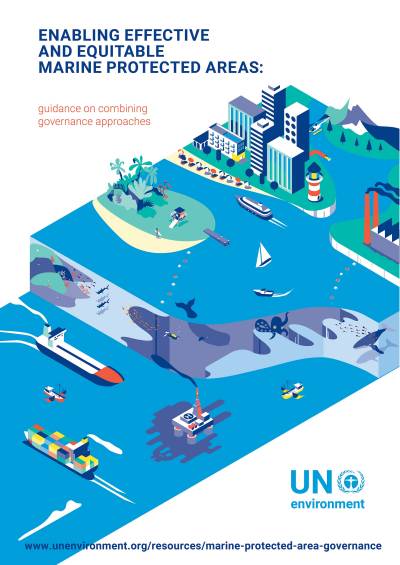
UN Environment have launched new guidance, which can be freely downloaded here, based on this MPA Governance Project. The guidance on combining governance approaches is evidence-based, drawing on 34 case studies in 19 countries around the world (see Case Study Compendium), providing a flexible governance analysis and capacity-building framework, recognising that there is no 'one size fits all' approach to the governance of MPAs.The Guidance focuses on how a) top-down, b) bottom-up, c) market-based, d) awareness-raising & e) collective learning governance approaches can be combined to: 1) influence human behaviour in order to 2) reduce use impacts to 3) mitigate conflicts, 4) thereby increasing conservation effectiveness 5) in an inclusive way that fairly shares costs & benefits. It takes a social-ecological systems perspective in arguing that in same way that a diversity of species promotes the resilience of ecosystems, a diversity of governance incentives promotes the resilience of governance & related social systems, i.e. provides for the co-evolution of two systems.
The focus is on promoting both effectiveness in achieving conservation objectives and equity in fairly sharing the costs and benefits through participative approaches that respect local traditions, customs & cultures. Rather than assuming that MPAs are set-aside from use, the guidance recognises that MPAs should be seen more as vehicles for promoting integrated and sustainable use, which helps achieve a diversity of Sustainable Development Goals, including SDG14 (Life Below Water, related to Aichi target), but also others such as SDG1 (No Poverty), SDG2 (Zero Hunger), SDG8 (Decent Work and Economic Growth), SDG10 (Reduced Inequalities), SDG11 (Sustainable Cities and Communities), SDG13 (Climate Action) and SDG16 (Peace, Justice and Strong Institutions). As such, the UN Environment guide aims to provide practical, accessible and evidence-based advice to MPA managers and related policy-makers and interest groups on how to build capacity for effective conservation and integrated and equitable development, as well as providing a novel perspective on theories of natural resource governance. As UN Environment concluded in their Frontiers 2017 report, which included an article highlighting MPA governance challenges and new approaches (pp.35-46), “Ultimately, governing the oceans in a sustainable way could see Marine Protected Areas as a driver – not a limit – for the vital economic and social benefits that we derive from the global ocean”. A briefing on the this MPA Governance guidance and the background to it is available here and a summary of it by the SDG Knowledge Hub is available here
MPAG rationale in UN Rome Call to Action and Scientist's Consensus Statement following Government of Italy and OSA 10X20 Conference
The MPAG rationale and findings formed the basis of the governance stream of the international 10X20 Conference (7-9 March 2016, Rome) to support the achievement of a globally agreed target to conserve at least 10% of coastal and marine areas by 2020 (SDG 14, Target 5). This is part of the 10X20 initiative, organised by the Government of Italy, the United Nations Environment Programme and the Ocean Sanctuary Alliance. The first two days of the conference involved 25 international experts in discussions on good practice for measures to designate and promote the effectiveness of marine protected areas (MPAs), focusing on science, governance and finance. During the third day, diplomatic representatives from 33 countries from around the world joined the conference to agree a Call to Action and Scientists' Consensus Statement, which will help guide national governments, United Nations agencies and development donors over the next 15 years in MPA projects around the world. Slides of opening keynote on MPA governance - Information bulletin on this conference and the outputs
Paperback published
Paperback version of the book Governing Marine Protected Areas: resilience through diversity available, see Routledge web site for this book to purchase at 20% reduced price of £26 or US$42 using discount code DC361
The MPAG Project
This project and the related book - Governing Marine Protected Areas: resilience through diversity - addresses some important challenges related to the effective and equitable governance of marine protected areas (MPAs). These challenges are explored through a study of 50+ MPA case studies from around the world (20 explored in book, 34 in UN Environment Guidance). A novel governance analysis framework is employed to address some key questions: How can top-down and bottom-up approaches to MPA governance be combined? What does this mean, in reality, in different contexts? How can we develop and implement governance approaches that are both effective in achieving conservation objectives and equitable in fairly sharing associated costs and benefits?
This project and the book explore the many issues that these questions raise, as well as exploring options for addressing them. A key theme is that MPA governance needs to combine people, state and market approaches, rather than being based on one approach and its related ideals. Building on a critique of the governance analysis framework developed for common-pool resources, the book and related UN Environment Guidance puts forward a more holistic and less prescriptive framework for deconstructing and analyzing the governance of MPAs. This inter-disciplinary analysis is aimed at supporting the development of MPA governance approaches that build social-ecological resilience through both institutional and biological diversity. It will also make a significant contribution to wider debates on natural resource governance, as it poses some critical questions for contemporary approaches to related research and offers an alternative theoretical and empirical approach.
This project is a collaboration amongst a group of governance experts, led by Dr Peter JS Jones (Dept of Geography, University College London), in partnership with Ole Vestergaard and with funding from UN Environment. It was established to analyse MPA case studies and develop guidance on governing MPAs in seas under national jurisdiction. An initial sample of 20 MPA case studies from around the world was brought together in the preliminary phase and subjected to detailed analyses employing a new governance analysis framework, ‘deconstructing’ the complexities of MPA governance (MPAG) employing 36 incentives from five categories. The book describes the findings of this work. It is intended to provide a foundation for further discussions and learning, employing the governance analysis framework in different contexts, and to provide a preliminary resource for MPA managers to consider how different incentives might be combined to support the governance of their MPA. The MPA governance analysis framework includes descriptions of the five MPA governance approach categories and the 36 incentives that can be applied in these approaches.
The book Governing Marine Protected Areas: resilience through diversity (published 25 February 2014) describes this framework, its theoretical background and the details of its application to 20 MPA case studies around the world in much more detail. The book is available from Earthscan/Routledge (see seven reviews at this site) - purchase at 20% reduced price of £26 or US$42 using discount code DC361. See publisher web page and blog for more details on this book.
Building on the original 20 case studies, the MPA governance analysis framework has since been applied to a further 30 case studies, forming the basis for a comparative analysis of different governance approaches amongst 50 case studies, with 15 currently being written-up for a forthcoming special section of Marine Policy. The findings of the analyses of the 50 case studies will be published in the near future. If you are interested in undertaking further case studies employing the MPA governance analysis framework (including descriptions of 36 incentives) as part of your academic (including masters, doctoral and post-doctoral) or vocational (MPA managers, etc) studies, please do contact Peter Jones.
Other recent developments
- Open Channels webinar July 7 2021 - How to use diverse incentives to promote effective and equitable MPA governance: New case studies and practical guidance - slides
- Marine Protected Areas: securing benefits for sustainable development - MPAG research is one of six highlights featured in UN Environment's Frontiers 2017 report recently launched at the UN Environment Assembly, Nairobi, pp.35-46 of Frontiers 2017 - "Ultimately, governing the oceans in a sustainable way could see Marine Protected Areas as a driver – not a limit – for the vital economic and social benefits that we derive from the global ocean"
- MPAG findings and recommendations drawn on at WorkshopTowards Brazil's National Target 11 - The MPAG rationale and findings formed the basis of the opening presentation of the case studies session of this recent workshop (10-12 April 2018), organised by the Ministry of the Environment of Brazil and UN Environment. This is part of Brazil's initiative to develop a white paper: Options for enhancing management of marine protected areas and other effective area-based conservation measures. The MPAG presentation included some recommendations for this new national MPA strategy, which can be found in the slides of the MPAG presentation (from slide 29, also translated into Portuguese
- Presentation on relevance of findings of MPAG case studies to MPAs in UK at ACOPS Dialogue on the future of MPAs in the UK at the House of Lords
- "The scientific case for Marine Protected Areas (MPAs) is now overwhelming. The bigger question is how can they be managed more effectively?" Special Report by Horatio Morpurgo published in The Ecologist based on this book and the findings of a case study of Lyme Bay MPA
Review published in International Journal of Marine and Coastal Law: "The book draws upon an interesting range of examples from around the globe and it could attract a wide readership from amongst those interested in the management of MPAs from the perspective of national law...interesting use of case studies and examples could provide inspiration for anyone interested in designing or reviewing a management framework for a MPA within national jurisdiction."
Slides of presentation at OECD workshop on Marine Spatial Planning (Lisbon 5 June 2015): MPAs and MSP: co-evolution or competition? This presentation looks at the evolutionary links between MPAs and MSP, and argues that integrated-use MSP is becoming a competitor to ecosystem-based MSP, including the marginalisation of MPAs. It considers the need for analyses of the effectiveness of MPAs in an EU context, employing the MPAG analysis framework.
Invited contribution, based on the MPAG project, to commissioned book: pp.623-626 of ‘Chapter 20 - Marine Protected Area Management’ in Protected Area Governance and Management (February 2015). Legacy document from the World Parks Congress.
- Comment in Nature based on book as part of 'to-do list for the world's parks' - Assess Governance Structures
- Book reviewed by Nathan Bennett in Conservation Biology- 'Governing marine protected areas in an interconnected and changing world'. His review raises the question of whether Bennett fully read and understood the book, see the review and my response in the comments here (download and view with Adobe Acrobat Reader)
- Comprehensive and positive review of book by Bob Earll: "This book does the rare thing of putting the social into the socio-ecology of protected areas and provides valuable insights into natural resource management in general... This is a very significant book providing clarity of structure, evidence and insight into the neglected area of social science and marine protected areas. This insight has a value way beyond MPAs, to marine conservation and environmental issues in general."
- Interview in MPA News drawing on Governing MPAs book - Achieving conservation objectives and social equity goals
- Book briefly reviewed in Nature on 20 March (Vol 507, p.305): Barbara Kiser notes that MPAs cover little more than 2% of the world's oceans despite an internationally agreed target of 10% by 2020. As many scientists have found, thousands of those that do exist are also little more than 'paper parks'. She adds: "Entering these choppy waters is geographer Peter Jones, who shows, through some 20 case studies, how and how not to govern MPAs effectively. Jones compellingly concludes that a diversity of incentives, from economic to social, is as essential as the diversity of the ecosystems MPAs are designed to protect."
- Linked In discussion group established on MPA governance questions arising from the case studies, and on related papers, issues, potential case studies, etc
- Special Issue of the journal Marine Policy based on MPAG research findings published - Governing marine protected areas: towards social-ecological resilience through institutional diversity - includes introductory paper (journal version and open copy), synthesis paper (journal version and open copy) and 15 case study papers - See Outline and Full Contents List: English, Spanish and Portuguese version
- Nature news feature 'Ocean Conservation: uncertain sanctuary' discusses some of the findings of this report. The editorial of this issue of Nature discusses this news feature: 'Troubled Waters'
- MPA News feature on MPA Governance report
- Technical report published - Governing Marine Protected Areas: getting the balance right - Volume 1 Main Report - Volume 2 Case Study Reports (March 2011)
Next MPAG phase: global multiple case study analysis
The pilot phase of the marine protected area governance (MPAG) project, funded by UNEP, provided for the development and testing of an analytical framework for deconstructing governance in any given MPA. Funds are now being sought to apply this MPA governance analytical framework to a larger number of MPA case studies around the world, the target being 200 case studies. We have already undertaken a further 30 case studies (in addition to the original 20 case studies) on an opportunistic basis with masters and doctoral students and enquiries from research students who are interested in applying the MPA governance analytical framework are most welcome.
These MPAG case studies will contribute to a qualitative multiple case study analysis which will assess the effectiveness of MPA governance institutions in achieving biodiversity and resource conservation objectives, whilst addressing equity issues, with the aim of systematically analysing the different combinations of incentives that are effective in particular contexts, providing for the identification of 'good practice' in MPA governance, including the potential for the transferability of good practice to other MPAs. This will provide a vital resource for MPA managers as well as providing for comparisons of MPA effectiveness with the governance approach employed. Please contact Dr Peter JS Jones if you have any suggestions for funding or further case studies, including as part of your academic (including masters, doctoral and post-doctoral) or vocational (MPA managers, etc) studies.